
NEWS & RESEARCH
Brook Street Blues: How a Winchester Water Dispute Became a Human Right
It is World Water Day and so we thought we’d celebrate by sharing a blog post that tells the amazing story about one woman and the waterways in Winchester, and how her campaign impacted on the world today.
It is World Water Day and so we thought we’d celebrate by sharing a blog post that tells the amazing story about one woman and the waterways in Winchester. Water of course is critical to our survival, providing hydration and enabling us to grow food. It is also;
‘used for washing. It was used for transport. It was used for, particularly in Winchester, it was used for weaving and fulling and all the sort of cloth trades’

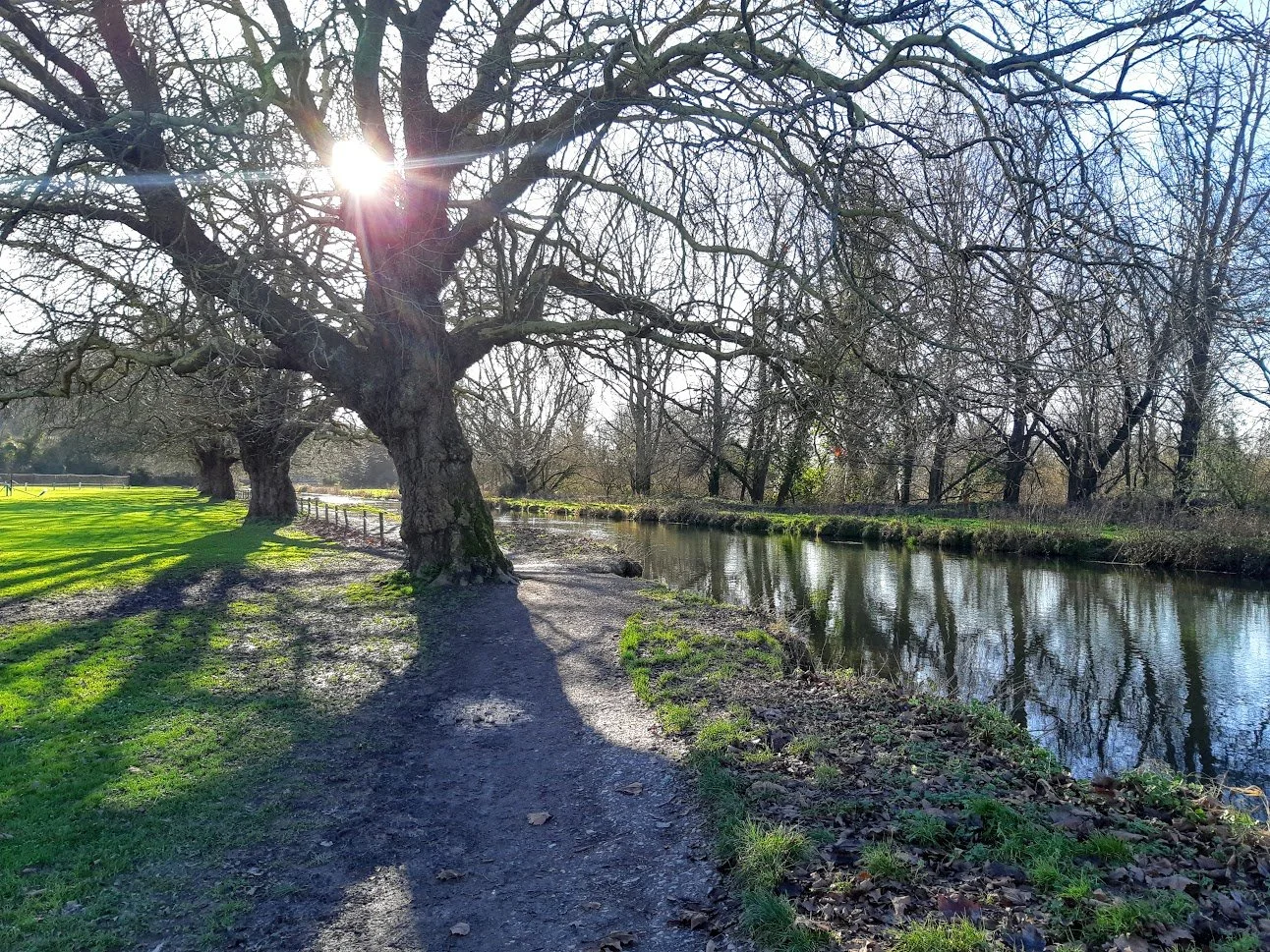
River Itchen running through Winchester
Tomorrow we’ll tell more about Winchester Waterways in a brand new podcast, when we share the fascinating history of the River Itchen and its significance for Winchester and its local people. Today’s story though is about an extraordinary woman.
In 1299, around 11,000 people lived in Winchester. One of which was Juliana de la Floude. She lived on Shulworth Street, now Upper Brook Street, and worked in her laundrette which was also based in Winchester.

Watercolour of Middle Brook Street attributed to S. Prout R.A. 1813. While this street would have looked slightly different in Juliana’s time, this provides you with an idea of what her street would have looked like
As she worked in a laundrette, it was crucial for Juliana to have a constant flow of clean, running water so that she could clean clothes, thread and yarn for those who used her laundrette.
However, this became problematic when John de Tyting polluted and obstructed the flow of running water to her business. John de Tyting was one of Brooks’ richest residents. He was Alderman of Winchester (a City Councillor in today’s world) and twice Mayor and MP of Winchester.
As they could not settle this dispute between themselves, Juliana wrote to King Edward I and asked him to restore her water supply.

Edward I
He appointed a Commission of local residents from Upper and Lower Brook Street to look into the complaint. The findings of the Commission were shared with the King in the Great Hall in September 1299. Based on these findings, he concluded that “water has always been common”. By this, he meant that all residents have a right to access clean, running water. After this address, the King attached a number of regulations to the Commission’s report and raised the findings from Common Law to Statute Law. This meant that dyes, tanners (sheep skins), butchers’ blood and human blood from barber shops and surgeons and raw sewage was not allowed to enter the River. This prevented anyone from contaminating Winchester’s local water supply.
While Juliana was just one woman who was trying to keep her business afloat, her actions are of great significance. After the ruling, Juliana became known as Juliana de la Floude which translates to Juliana of the Water.
Not only this, but this ruling was later renamed the Concordance de Julian which included the King’s famous words “water has always been common”.
Today, Juliana’s efforts remain just as significant as they were in 1299. These famous words uttered by the King are enshrined in the United Nations Convention of Human Rights. They are used to justify the idea that access to clean, running, drinking water is not a luxury, it is a human right! This has ensured that billions of people all around the world have access to fresh flowing water.
So, next time you put a load in your washing machine or get a glass of clean water from the tap, take a moment to think about Juliana’s courage and amazing work in unblocking Winchester’s waterways. Who would have thought that the simple act of blocking water flow to a small laundrette in the heart of Winchester would have such long lasting significance?!
If you enjoyed reading this then watch out for our special Water Ways podcast being released tomorrow!
Further Reading:
Keene, Derek. Survey of Medieval Winchester. Oxford: Oxford University Press, 1985.
Want to learn more about how Juliana’s work relates to present day? Click on the link below to read more about Juliana as her work and this infamous dispute is discussed within the Winchester Town Forum.
World Water Day 2022 is encouraging us to make the invisible visible. And by invisible they mean groundwater - it is invisible, but its impact is visible everywhere. Almost all of the liquid freshwater in the world is groundwater. As climate change gets worse, groundwater will become more and more critical. Groundwater may be out of sight, but it must not be out of mind. Find out what you can do here https://www.worldwaterday.org/
Photo Credits:
‘flickr, River Itchen,Winchester’, , https://www.flickr.com/
‘flickr, Edward I’,, https://www.flickr.com/
Hampshire Cultural Trust, ‘World Water Day: the washerwoman, the MP and the King’, https://www.cultureoncall.com/world-water-day/

A Tale of Two Salisburys
Sandy beaches, boardwalk arcades, and deep-sea fishing: hmmm that doesn’t sound like Salisbury in Wiltshire. However that’s what one of our volunteers thinks when they think of Salisbury!
We’re delighted to share this great blogpost, written by one of our University of Winchester volunteers - Kyle Flaherty. You can discover more about Kyle on our HistBites team page.
Sandy beaches, boardwalk arcades, and deep-sea fishing: I’m sure these aren’t exactly the first things that come to mind when you hear the name Salisbury. But over three thousand miles away from the busy cathedral city in Wiltshire, there’s a little beach town in Essex County, Massachusetts with the same name.
When I moved out of Salisbury, Massachusetts and arrived in England back in 2019, one of the first things I noticed was how many town names that New England had borrowed from it. Andover, Portsmouth, and Amesbury were places I visited frequently, so seeing their names pop up on road signs was a unique experience for me!
How homesick Puritans started a tradition
New England has the Puritans to thank for many of its historical connections with England. Puritanism was one of the many religious movements that emerged in 16th century Europe during the Protestant Reformation. While the movement was widely tolerated under Elizabeth I, that changed when many Puritans accused the Church of England of not going far enough with its reforms. They saw practices like the use of music and incense during worship or using rings in marriage as being too similar to Catholicism.
Under James I, these disagreements caused many of them to separate from the Church of England. As the King was the leader of both the Church and the state, this decision was seen as a direct insult to him. Many faced criminal prosecution, while others were even executed for their beliefs. Because of this, they fled to Holland where they lived in exile.
In 1619, a small group of exiles returned to England to gain support for a permanent home in America, and in the next year, these Puritans set sail aboard the Mayflower. When they landed in Massachusetts, Plymouth Colony was founded and the tradition of naming new settlements after places in England began. Throughout the next century, familiar names such as Southampton, Reading, Winchester, and Boston began to appear across Plymouth Colony and the Massachusetts Bay Colony.

The Puritan by Augustus St Gaudens. Photo by Carol M Highsmith
Salisbury and Salisbury—a troubled history
Eighteen years after Plymouth Colony was founded, a small group of colonists reached the northernmost point of Massachusetts, where the Merrimack River flowed into the Atlantic. These wetlands were once used by Pennacook peoples for fishing and hunting until European diseases and conflict with neighbouring Mohawk tribes pushed them out of the area.
The Massachusetts Bay Company granted the colonists’ request to build a settlement, and the town of Colchester was born. Only—they changed the name to Salisbury a month later; one of the colonists was an influential member of the company from Salisbury, England.
Life in 17th century Salisbury was hard. The dead were buried with granite slabs over them to prevent wolves from digging up their graves. Three of its residents were accused of witchcraft during the Salem Witch Trials. Outbreaks of smallpox and influenza were common.
In the same century, Salisbury, England had its own share of struggles. With the English Civil War raging across the country, it wasn’t long before the conflict reached the city itself. Salisbury Cathedral suffered damage and looting, while the Bishop’s Palace was almost entirely destroyed. Additionally, parts of the cathedral were used to hold Dutch prisoners of war.
During the Second World War, both places felt the rippling effects of war. In Salisbury, Massachusetts, the US Department of War turned Salisbury Beach into a fortress. After the Japanese attack on Pearl Harbor, they built coastal defence batteries, military barracks, and observation towers to ward off any potential attacks against the neighbouring Newburyport Harbor. However, the Axis powers never took an interest in the small Massachusetts beach town.
Luckily for Salisbury, England, it too escaped the war mostly unscathed. Its centuries-old cathedral was spared by Luftwaffe bombing as it was used by pilots as a landmark toward other locations across the UK. However, the city was an important staging ground for Commonwealth forces, as well as Americans and Poles. In 1943, American soldiers built a boxing ring in Victoria Park, where American heavyweight champion Joe Louis fought the English middleweight champion Freddie Mills in an exhibition match.
Why I love Salisbury
In the modern-day, both Salisburys have found their success with tourism. People across Wiltshire and beyond make the trip to Salisbury for its bustling markets and rich history, while Salisbury, Massachusetts is a popular destination with New Englanders for its sunny beaches, fried dough, and lively boardwalks. Both places are immensely beautiful in their own ways.
Salisbury, Massachusetts is a typical New England beach town. If you’ve never been to one, think of Amity Island from Jaws, but without the man-eating shark (the film was shot in Massachusetts!). Along the boardwalk, the salty smell of the ocean mixes with the scent of pizza. Gulls caw, the ocean crashes against the bright yellow sand, and the occasional fisherman shouts in excitement at catching a striped bass from the shore. Many of the shopfronts still have original signs from the 1970s, but for me, that’s part of the charm.
In Salisbury, England, one of the first sights I saw when visiting was the River Avon. I was taken aback by its clear water and the vibrant green grass within it. In the city itself, traditional pubs and shopfronts line its twisting cobblestone roads and open market. While walking along Butcher Row, I discovered that some of the buildings even date back to medieval times.
Visiting the cathedral was a humbling experience as well. Its towering architecture and expansive hall absorbed all sound, while the stained glass windows bathed the inside in natural light. I was sad when my visit to Salisbury was over, but the city was a wonderful introduction to England and one that I will never forget.

Interior of Salisbury Cathedral
Growing up in Salisbury, Massachusetts, I never spent much time questioning the origin of the name. In the years I’ve spent living in England, however, I have discovered a unique link between two places across the globe. While the two Salisburys have dramatically different atmospheres, cultures, and histories, they are both wonderful places and I am deeply grateful to have seen both in my lifetime.

Hampshire Churches and their hidden royal past
On this day in 2020 we released a fabulous podcast on Mary l’s and how her legacy had been hidden in Winchester Cathedral, in this extended post volunteer Lydia explores more hidden royal stories in other Hampshire churches
‘As one group’s narrative triumphs over others, anything that does not fit the dominant narrative is rejected.’
These are words taken from Johanna Strong’s podcast episode Winchester and Westminster: How did these churches forget Mary I? She explains how our desire to establish a strong Elizabethan historical memory has caused us to somewhat forget the reign of Mary I. While her reign was short-lived, it plays a very significant part within Britain’s royal and religious history. Not only this, but Mary also established important connections with various churches such as Winchester Cathedral and Westminster Abbey as this episode goes on to explore. However, many have forgotten Mary’s connections with these great Churches across Britain. So, this got me thinking, what other churches have a forgotten royal past?
St Peter’s Church, Titchfield
Hampshire’s oldest Church dating from 680 AD, this in itself gives this Church great historical importance! Travelling to Titchfield via sea, Saint Wilfred came South from Northumbria and established St Peter’s Church with the aim of converting the local tribe to Christianity.
St Peter’s Church, Titchfield
However, its St Peter’s forgotten royal connections that I found most intriguing. Throughout its long history, it has housed a variety of British monarchs. In 1349, Richard II and Queen Anne stayed at the Abbey which began its life in 1232. In the 15th century, Henry V stayed at the Abbey on his way to France, where he won the Battle of Agincourt in 1415. Additionally, Charles I stayed in Titchfield before moving onto the Isle of Wight where he was later imprisoned.
Therefore, while this may seem like just a Church in a small village in Southern Hampshire, it has rich royal connections that span its long and impressive history!
St Mildred’s Church, Whippingham
St Mildred’s perhaps has the most significant royal association. The Church of England parish church of the village of Whippingham on the Isle of Wight, this Church is deeply connected to Queen Victoria and her wider family.
Many people have ventured to the Isle of Wight to see the splendid Osbourne House, the holiday home loved by Victoria and Albert. However, few are aware of the significance St Mildred’s had within their lives. Just a short ride from Osbourne House, St Mildred’s served as the parish church for this royal family.
The original church was dated from before the Domesday Book but was demolished. It was re-built by architect John Nash in 1804. Queen Victoria had visited and worshipped in this Church. However, once she had Osbourne House, she wanted a newer and more impressive church which she and her wider family could enjoy whilst on holiday. Working alongside architect A.J. Humbert, Prince Albert redesigned the Church. In 1854 the Chancel was rebuilt and the rest followed suit in 1860.

St Mildred’s, Whippingham
Other members of the family were also involved with the redesign. Princess Louise designed the stone font and her and her sister, Princess Beatrice, designed the carpet placed around the font. Princess Beatrice embroidered the carpet in Battenberg Chapel, an area within this Church. Victoria also left her mark as she gifted the stone used for the font, designed by her children, and a pair of wrought iron candelabra.
From Victoria’s journals we can gain an understanding of how long St Mildred’s took to rebuild. On Tuesday 29 May 1860 Victoria describes how she ‘drove to Whippingham, where, with due ceremonies we laid the 1st stone of the new part of the Church, the old part having all been pulled down’.
Not only this, but from her journals we can also gain an insight into Victoria’s opinions of the redesign. Complaining about the progress, Victoria later writes on Monday 19 August 1861 ‘the Church, which makes no progress’. Finally on Thursday 10 April 1862 she writes ‘the pretty Church at Whippingham, which is now quite finished, all but putting in the tiles on the floor’.
Although heavily involved in the redesign of the Church, unfortunately Prince Albert never lived to see his design completed. However, this only adds to the historical and royal significance of St Mildred’s. After his death in December 1861, Victoria erected a memorial in St Mildred’s in Albert’s name. Placed within the Church and unveiled in 1864, this monument consists of two angels holding a wreath of stars over a medallion of Prince Albert. Stars were an important symbol of remembered for Albert because they were found on the ceiling of the room in which he died at Windsor Castle. This was not uncommon behaviour from Victoria. As most are aware, after Albert’s death memorials dedicated to him appeared all over Britain, most notoriously The Albert Memorial in Kensington Gardens and The Royal Albert Hall, named in his memory.
In addition to Albert’s monument, there are also memorials to Prince Leopold, Victoria’s youngest son, Princess Alice, her second daughter and a tablet to the two sons of her eldest daughter, Prince Sigismund and Prince Waldemar. Upon her death, Victoria requested that her own blue chair and cushion for her feet were to be placed in the Royal Pew. It was installed by her son, King Edward VII who also established a tablet in her memory. Additionally, memorials to Victoria are present throughout the Church in the form of white marble reredos and copper and oak pulpit.
While for some St Mildred’s may seem a sight of remembrance, for others it is a sight of marriage. On 23 July 1885, Victoria’s youngest child Princess Beatrice married Prince Henry of Battenberg. This was the first time a royal bride had been married in an English parish church and is captured in vivid detail in Victoria’s journal entry. After marrying in St Mildred’s, the couple made Osbourne House their permanent home. In 1890, a private suit was built for them on the first floor of the new Dunbar Wing. When Prince Henry tragically passed away after contracting malaria in 1896 while campaigning on the Gold Cast in the Ashanti War, Victoria made the Battenberg Chapel into a shrine for him. This is where he is buried. When Princess Beatrice died in 1944, she was later buried with him.
It is known that Victoria visited and was particularly fond of St Mildred’s Church as it is mentioned on numerous accounts in her journals which span 1832 to 1901.
The first reference to St Mildred’s appears on Sunday 22 June 1845 whilst residing at Osbourne House. Talking about the Church Victoria writes, ‘we attended afternoon service at Whippingham Church, where Mama and I used to go so often 12 & 14 years ago’. This indicates that St Mildred’s was not only a place where Victoria took her own family, but it was also a place that she travelled to as a young child.
We can also obtain a sense of what the St Mildred’s was like at Christmas. Victoria’s entry on Sunday 25 December 1864 explains that she ‘went to afternoon service to Whippingham, where the Church was so prettily decorated with holly, but it was very dark & very cold’.
From Victoria’s journals we can gain invaluable insights into how often she frequented the Church, her opinions of it and a glimpse into what the Church looked like during Victorian Britain. Who would have thought that a Church on the Isle of Wight has such a fascinating past!
Romsey Abbey
In more recent years, Romsey Abbey has established royal associations as it is often visited by members of our own living royal family.

Romsey Abbey
Second cousin once removed of Queen Elizabeth II; Lord Mountbatten is buried in Romsey Abbey after he was tragically assassinated by the IRA in 1979. As an important and well respected member of the royal family, he was visited every Advent by Queen Elizabeth and Prince Philip from the year of their honeymoon up until 1980. It is unknown how frequently the Queen now visits. Nevertheless, this is another Church that is an important part of Britain’s royal history.
To learn more about Romsey Abbey’s fascinating past have a listen to Romsey Abbey; A Haven, an educational opportunity or a place of power? and The Heritage of Bell Ringing in Hampshire.
Before writing this post I was unaware of what, if any, royal connections I would find with our Churches in Hampshire. However, I was pleasantly surprised. As someone who is continuously fascinated with the Victorian period, it was amazing to learn about Victoria and Albert’s deep connection and love for St Mildred’s. Next time I am on the Isle of Wight I will definitely be visiting! As a historian I love learning about the past and discovering new things. I hope that this post has encouraged readers to reconsider their local area and the rich history that is often looming just around the corner.
Just as Johanna Strong highlighted the importance of challenging the traditional historical memory and narratives, this post has alluded to the notion that there are narratives and stories out there that have perhaps been lost through time. By researching in and rediscovering our fantastic local history, this post has shown that almost everything has a rich past worth remembering.
Photos:
‘flickr, St Peter’s Church, Titchfield’, accessed December 12, 2021, https://www.flickr.com/
‘flickr, St Mildred’s Church, Whippingham’, accessed December 12, 2021, https://www.flickr.com/

Love, labour and colour: the work behind a Book of Hours
Volunteer, Lydia Ackrell, takes a closer look at the Book of Hours, which was featured in one of Hampshire HistBites very first podcasts.
‘This book allows you to contemplate the mysteries of God expressed naturally, expressed beautifully’.
In an age where, for some, religion is not as prominent in their lives as it once was, how can we keep religion relevant and interesting to large numbers of people?
This interest of mine arose after listening to the ‘Hidden Pages & Hidden Nature: A Book of Hours Revealed’ podcast, available here. Being religious myself, I was fascinated to learn about how those before me managed their faith. However, it also drew me to this question: how does our understanding of this Book change when we consider it as a work of art, rather than just as a religious text?
This Book of Hours, see Figure 1, was created by Master of the Échevinage of Rouen, the most prominent illuminator in Rouen from around the mid to late 15th century.

Figure 1: A page from the Book of Hours
As evident from its name, a Book of Hours detailed various Christian prayers and at what time of day, hour, they needed to be said. Often owned by the lay people, these Books allowed for many, although predominately women, to engage with the Christian faith. Being an important religious text, it is only expected for these Books to contain beautiful illustrations with vibrant colours in homage to the holy figures they detail. It is the way in which these paints were sourced, their significance and how they were later applied on vellum which will be the subject of this post.
Vellum, calf skin, was the base material of choice. However, this material had to undergo much work before it became the pages for the finished Book that we see today. First, to remove any hair and flesh, the skin was soaked in a lime solution and then stretched to the desired length and thickness. Once dried, the skin was cut into smaller sheets, creating the pages. Then, to ensure that the text would be written in straight lines, a line of small dots was made in the vellum using the tip of a sharp knife. The page was then ready to be inscribed and painted upon.
Sourcing the paints was not an easy process. Unlike today where one can take a trip down to their local craft shop, during the medieval period, paints were sourced in a much more time-consuming method. A method which heavily depended on the colour of the paint required.
Ultramarine was a new colour to the medieval period. Sourced by extracting the bright blue mineral lazurite from lazuli stones, see Figure 2, this was a very expensive shade of blue to obtain as these stones had to be mined from Afghanistan.

Figure 2: Lazuli stone in its natural state
However, despite its cost, ultramarine is found on numerous occasions within manuscripts, especially when depicting very important religious figures such as the Virgin Mary, see Figure 3. Being the mother to the Son of God, Mary was a very significant figure within Christian iconography. Thus, it was important to use a paint which complemented and highlighted the significance of the figure that it was capturing, and so, ultramarine with its high cost paid homage to the Virgin Mary and her religious significance very well.
Additionally, as blue is the colour of the Virgin and ultramarine provides such a vibrant shade of this colour, it was only natural that ultramarine was always the shade of choice which depicting Mary. This also helps explain why ultramarine is often found within other areas of the Book, for example within the foliage. As a Book of Hours also contained the Hours of the Virgin, where these prayers are present, tends to be where ultramarine has been used in abundance, as evident from Figure 3.
Figure 3: The Annunciation
As this scene captures The Annunciation, where the Angel Gabriel came to Mary and told her that she would be mother to the Son of God, ultramarine is ultimately the colour that stands out. Thus, the history and cost behind obtaining ultramarine, in addition to its presence all over this scene, highlights the religious significance of this scene and the people it details.
If ultramarine was ever unavailable or a cheaper alternative was required, blue pigment was sourced from Azurite, see Figure 4.

Figure 4: Azurite stone
A blue stone that is rich in copper, it was found in many European countries and so, while it was less vibrant than ultramarine, see Figures 5 and 6 for a comparison, it was easier and cheaper to obtain than the lazuli stones mined in Afghanistan.

Figure 5: Ultramarine

Figure 6: Azurite
Additionally, a lighter shade of blue could be obtained from plants such as woad, see Figures 7 and 8.

Figure 7: Woad

Figure 8: Lighter shade of blue obtained from the woad plant
Another important colour was red because, while this was used for adoration, significant holy days were also written in red. By the medieval period a cheaper and manufactured version to the natural stone Cinnabar, see Figure 9, had been created.

Figure 9: Cinnabar
Thus, the material Vermilion, see Figure 10, was the manufactured material and, due to this, it was the one that dominated how artists created red paint during this time.

Figure 10: Vermilion
In addition to these, yellow was sourced from volcanic earth or saffron, white pigment was obtained from white lead, see Figure 11. Not only this, but green was sourced from the Malachite mineral, see Figure 12, pink hues were obtained from plants such as madder and purple was sourced from animals including sea molluscs.

Figure 11: Lead white

Figure 12: Malachite
It is also important to note the presence of gold within manuscript pages. Similar to the reasons as to why ultramarine was used, gold added an element of luxury and highlighted the significance of the figures it surrounded. Applied in a liquid form or as thin solid sheets (gold leaf), the presence of even the smallest bit of gold on a page created a heavenly and superior setting and placed the religious figures within their spiritual context. In addition to this, significant feast days were also written in gold letters, again highlighting their importance.
Therefore, it is clear that sourcing the necessary colour pigments was not an easy task. However, it did not stop there. Before the illuminator could apply the pigment to vellum to bring these beautiful pages to life, each pigment had to be turned into a fluid medium, paint, so that it could be applied to the page with greater ease. To achieve this, pigments had to be mixed with their complementary organic ‘binder’. During the medieval period, natural gums obtained from plants or eggs, mainly the egg white (glair) were commonly used as binders by illuminators. Once the pigment had been mixed with the appropriate binder, a fluid medium was created, what we now deem as paint. It was at this stage, when the illuminator could finally start to adorn the pages of vellum to create the manuscript designs that we see today.
Thus, creating and compiling materials necessary to construct Books of this kind comprised of a lot of different elements. It took skill and patience while waiting for each page and pigment to be prepared until it was ready to be worked on.
This post has explored the way in which these processes happened and by doing so has considered the question: how does our understanding of this Book change when we consider it as a work of art, rather than just as a religious text? While today some may not practice religion in the traditional sense, it is Books like these which highlight just how important religion and prayer was within medieval society. However, when we change this perspective and shift our focus onto this piece as a work of art, this adds new meaning and greater significance to this piece’s history. By adopting an artistic perspective, we can appreciate the delicacy, craftmanship and elegance of such a work. The way in which each pigment was sourced and applied to the carefully prepared vellum, highlights just how time consuming and special a book these Book of Hours really were, both to those interested in art and religion.
Credit: We are incredibly grateful to the Warden and Scholars of Winchester College for giving us the kind permission to share the image of a page from the Book of Hours with you all (Figure 1).
Post Author: Lydia Ackrell, Hampshire HistBites Volunteer

Festive Greetings
Wishing everyone a lovely Christmas, and we hope you can join us in 2022 for another great festival. The theme for next year is fantastic!
This morning we published our latest newsletter, and in it we confirmed the dates for next year’s Heritage Open Days festival.
Friday 9th to Sunday 18th September 2022
We do hope you can join us as the national team have come up with a fantastic theme for next year - Astounding Inventions. They are inviting us all to celebrate England's rich history of invention, industry and innovation. Whether it’s transporting visitors back to the industrial revolution, examining the inventions that power our daily lives, highlighting the legacy of a local inventor, or showcasing cutting-edge innovations. And this will of course be in addition to our usual array of brilliant events. We can't wait!
If you feel the same make sure you save the dates, or even better why not help us with next year's festival. There are so many ways you can get involved - you could become a festival sponsor, or maybe you would like to host an event yourself or perhaps you'd prefer to join our wonderful team of volunteers.
If you are interested in any of these opportunities, visit our Get Involved page to find out more. Otherwise who not take a peek at the rest of the newsletter as it includes links for some great podcasts to listen to and films to watch over the holiday period. You can read and subscribe to the newsletter here.