

When the Messiah came to Andover
Local historian Alex Beeton talks to Julie Dypdal about this fascinating tale and the light it shone on our society at the time
Hampshire during the English Civil War was a pretty miserable place. Looting was rife and the population politically divided and plagued by disease. Into this gloomy scene came the London rope-maker William Franklin, a self-proclaimed Messiah, who set up camp in Andover in 1649 with his female companion Mary Gadbury. Was he a visionary or a blasphemer?
Local historian Alex Beeton talks to Julie Dypdal about this fascinating tale, the fluctuating fortunes of Franklin and his band of followers and the light this shines on society at the time.

Alex Beeton
I am a second-year PhD student at Oxford University studying early modern British history. I grew up in Compton and have always loved local history. Winchester is full of fantastic stories, especially from the Civil Wars, and it’s great to have a chance to talk about them.
Alex will also be speaking at the 2021 Winchester Heritage Open Days on Winchester College during the Civil Wars and a curious story involving bribery and sugar.
“I’d recommend ignoring books and going to some of the places which still have traces of the seventeenth century. The Westgate Museum in Winchester has a really wonderful collection of early modern artefacts and is in a lovely setting. Winchester Cathedral and College also are full of stories and objects from the period.”

Ellis, H.,d.1676. (1650). Pseudochristus. London, Printed by John Macock, for Luke Fawn, and are to be sold at his shop at the sign of the Parrot in Pauls Church-yard. Retrieved from https://www.proquest.com/books/pseudochristus-true-faithful-relation-grand/docview/2240921816/se-2?accountid=27803
© ProQuest 2021
Wonder what happened to Mr. and Mrs. Woodward?
After the ordeal with the Messiah, Mr. Woodward lost his church living at Crux Easton, but reappears 10 years later in Kent in another church role. Bizarrely, Mr. Woodward starts to proclaim that he met the Messiah some years ago, a complete turnaround from his statement at the examination. This is in the 1660s and he suddenly reverts to this deeply held belief in the messianic nature of Mr. Franklin and it most probably loses him his job in Kent. It’s very hard to interpret why he went back to saying that Mr. Franklin was the Messiah: perhaps he truly was a sincere believer in 1649/1650 and had a moment of fear, trying to save his skin during the examinations. However, it is possible that Mrs. Woodward had a role in this rekindling of Mr. Woodward’s belief in the 1660s as she was the more active believer in the Franklinite cause (according to the sources).
While Mr. Woodward only spent one day in prison until someone paid security for him and he was released, Mrs. Woodward was indicted as a brothel housekeeper as she allowed un-married people to sleep under her roof in the same bed, which must have carried an enormous social stigma. And it is quite interesting that Mr. Woodward managed to find another church living after this complete humiliation.
William Franklin and Mary Gadbury: Some Final Thoughts
It’s not really clear what Mr. Franklin’s intention was when setting out to Andover and declaring himself the Messiah. When reading the pamphlet, they decide to go to Andover due to a vision. It also seems that Mr. Franklin intends on carrying on with his trade as a rope maker, but also to start preaching. So it is likely that the plan was to continue in a fairly normal life, but also to preach and start spreading the word while trying to be the Messiah.
Another interesting thing to note is that they had several followers: they had people coming to see them in prison and they received financial and physical support. But what is even more interesting is that Franklin and Gadbury attracted followers who gave themselves biblical roles: there’s a John who declared himself to be John the Baptist and there’s a Henry from Stockbridge who declared himself as a destroying angel.
In the end, Franklin and Gadbury don’t get charged with anything, but there are certain laws that came out of this incident (although this cannot be directly linked to the Messiah case, it is part of a wider societal context at the time). In 1650, a couple of important religious and moral laws are passed, including an Adultery Act which makes adultery or fornication punishable by death. And a Blasphemy Act, which specifically says people who declared themselves Messiah are going to be in trouble. Sound familiar?
Further Information and Additional Links
Be on the lookout for Alex’s appearance at the 2021 Winchester Heritage Open Day, where he will be discussing Winchester College during the Civil Wars and a curious story involving bribery and sugar.

Celebrating and remembering with Hampshire's oldest bells
Phil Watts, Bells Advisor for the Winchester diocese reveals all to Cathy Booth in this fascinating heritage podcast as he tells the stories of Hampshire’s extraordinary bells and shares how has bell ringing changed over the centuries.
On Sundays and feast days and in times of celebration and mourning bells ring out from Hampshire’s churches, abbeys and cathedrals to mark the occasion. It’s a practice that has continued since Saxon times, but where are the county’s oldest church bells which once rang to sound the curfew, or to remind households to cover their fires overnight? And where were they made?
Phil Watts, Bells Advisor for the Winchester diocese reveals all to Cathy Booth in this fascinating heritage podcast as he tells the stories of Hampshire’s extraordinary bells and shares how has bell ringing changed over the centuries.
Cathy Booth
Cathy Booth is the host of the Fun with Bells podcast, which she set up to support her husband who rings church bells in the English change ringing style. With a background in technology and interviewing, Cathy enjoys learning about different aspects of this fascinating hobby. Cathy also helped to set up the Hampshire HistBites podcast.
Phil Watts
An active Church Bell Ringer since 1970, Phil Watts has been involved in the care, maintenance and restoration of church bells for almost fifty years. He is presently Bells Advisor to the Winchester Diocesan Advisory Committee for the Care of Churches. A retired Chartered Land Surveyor, Phil has also served as a Churchwarden and in other roles in his local parish church.
Further Information and Additional Links
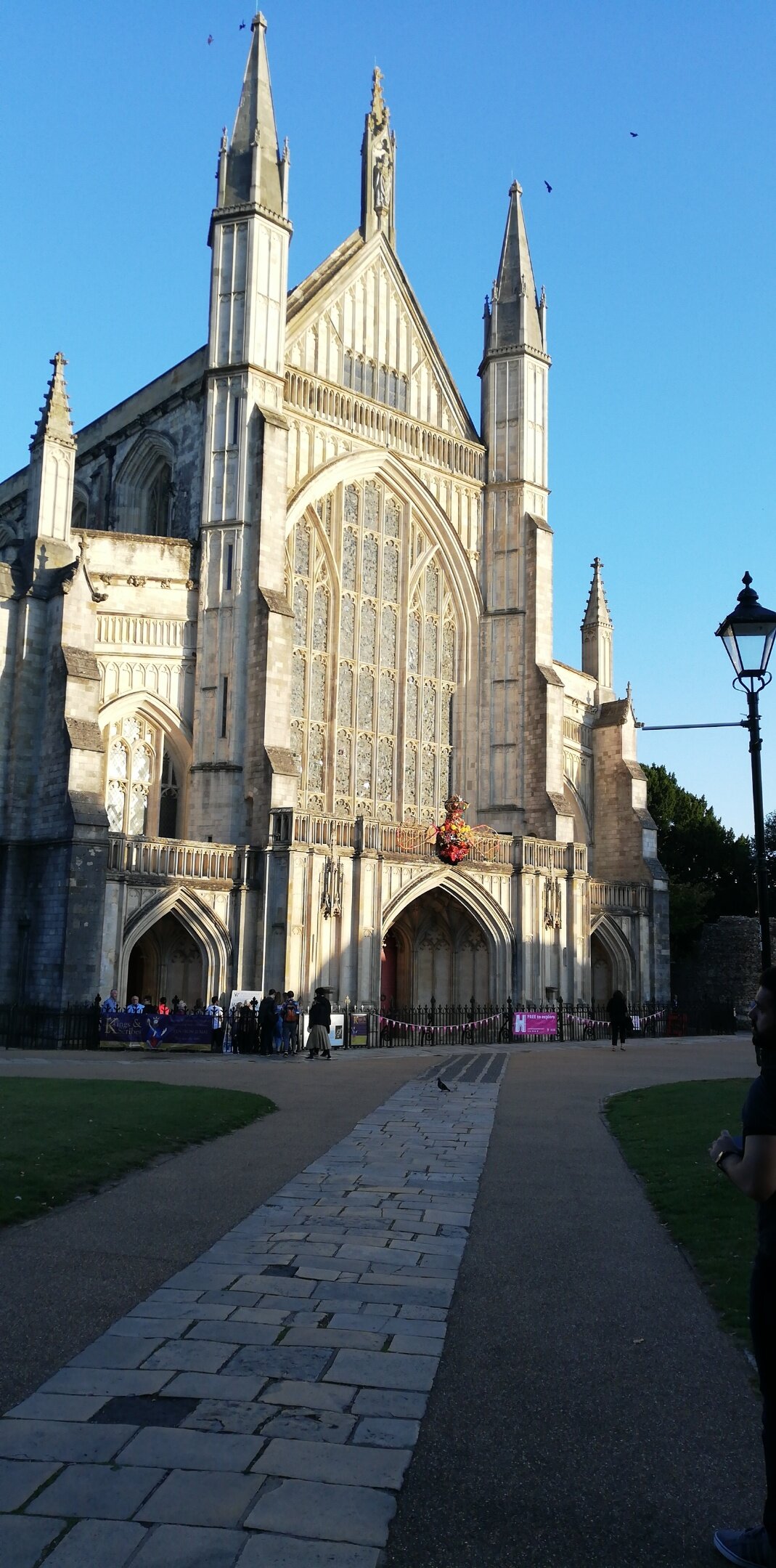
Visit the Winchester Cathedral website for more information about the Winchester Cathedral bells and to book a Tower tour, where you can view the bells at close range.
If you are interested in bells or want to hear more from Cathy, she has a podcast called Fun With Bells, which we recommend you listen to.
A Single Thread by Tracy Chevalier is set in Winchester and provides an interesting insight into bell-ringing here in the 1920s.