
NEWS & RESEARCH

Winchester's Hidden History: Chesil Street Tunnel
Can you name every heritage site in Winchester?
Can you name every heritage site in Winchester?
A few months ago I was naïve enough to answer yes to this question that was until I discovered the Chesil Street Tunnel. One of Winchester’s better kept secrets. Now many students will study at the university; see the Cathedral, wander through the barracks and think they’ve seen it all. Perhaps a resident takes notice of the Buttercross on their way to work, has been to the Great Hall once or twice but doesn’t realise the city’s hidden history. Now this article’s subject matter is not to be confused with the mysterious labyrinth of tunnels under the city. We’re going to be investigating Winchester’s forgotten second railway.
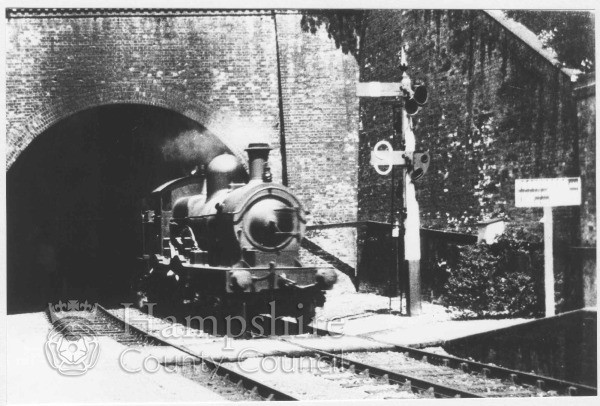
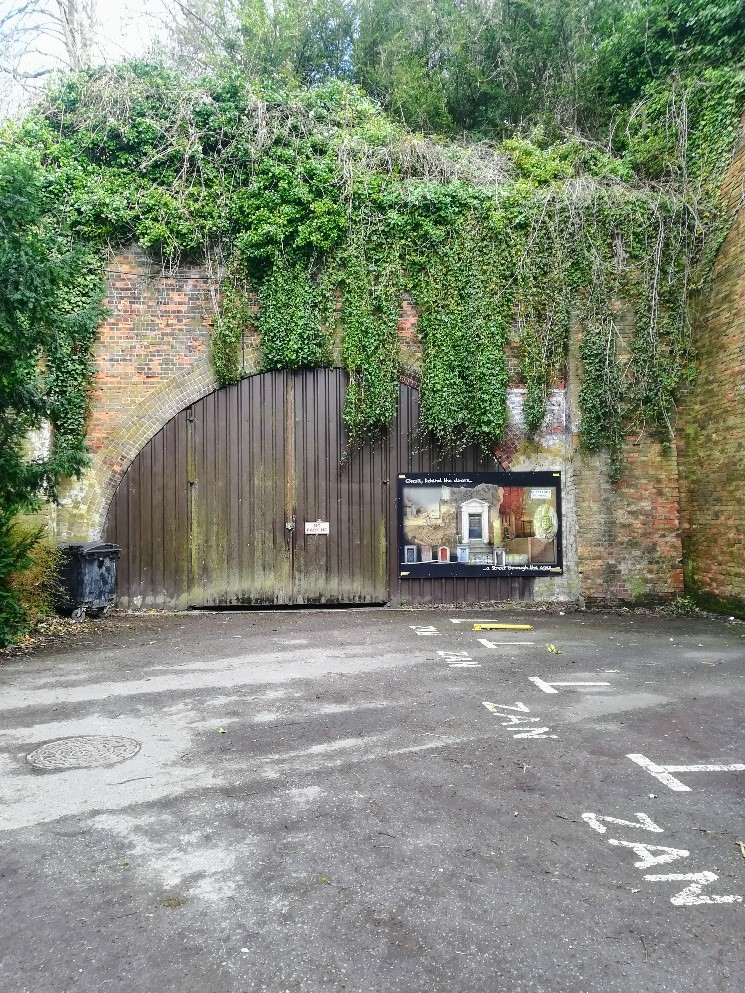
Photos 1 and 2
In 1873 a parliamentary bill was submitted for the construction of Winchester Cheesehill (Chesil) Station. On the 4th May 1885 it opened. Part of the Didcot, Newbury and Southampton Railway (DNSR – operated by Great Western Railway), Winchester was considered to be the most important station on the line. Located at the east side of the city, in what is now the Chesil Street Car Park. The original station was only able to reach as far as Bar End due to unfortunate financial difficulty and meant the DSNR’s race to reach Southampton was put on hold.
Fifteen staff members established this forgotten station as the largest in the city at the time. Amongst the staff were clerks, cleaners, firemen and porters to the guards, drivers and warehouse-men. Historical rumours in the city mention a station cat who was even known to ‘sport the correct attire’!

Photo courtesy of Hantsphere and is of the Chesil Station Staff.
In the past the Hampshire Chronicle have expressed the importance of the Winchester Chesil Station in the deployment of troops during D-Day in the summer of 1944. Unfortunately the Chesil Line would later become a victim of the 1960 Beeching Cuts although the line would continue to transport a variety of goods until the mid to late 60’s. Economic issues and rising labour costs suggested the Beeching Axe was the quickest way to minimise losses. The chairmen of the British Transport Commission stated that the number of railway staff members had fallen by a huge 26%. A crazy statistic but considering the increasing competition it’s not surprising!
Looking at Chesil Street and Bar End today, it’s quite hard to imagine these streets were once home to such a busy railway line. The station itself had a history of closing and reopening from 1942 through to the final closure on 7th March 1960 but even then it reopened the following two summers. They just couldn’t make their minds up apparently!

Photo courtesy of Hantsphere, Hampshire County Council website. Photo is of the centenary celebration at Chesil Station.
For those wanting to discover the remains of this hidden gem, head straight down to the Chesil Street Car Park. After a bit of walking around the area you can discover old gauge ties still visible in the fencing along the paths. Little reminders of the old company. Take note that the GWR colours were cream and brown whilst the LSNR were green, a tip for spotting others across the city. How many clues to the railway’s existence can you find?
A great mural can be found inside the car park of a steam train, a subtle reminder of the rich background the area once had. Little exists of the line in the present day, the Chesil Tunnel is one of few places that remain. Open annually, a guided tour each summer allows visitors to walk where the line once ran. I myself went for a look with the Manager of the site, Doug Ross. A special thanks to Doug for allowing me to explore.
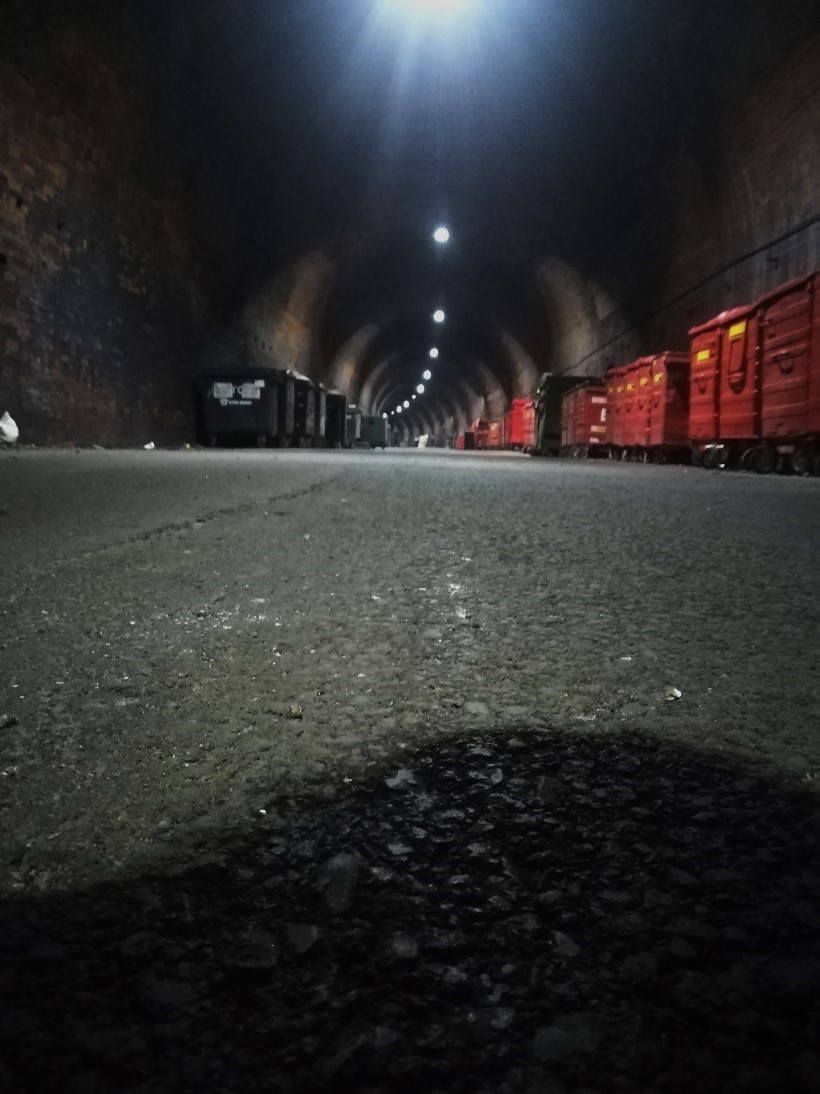
Photo taken by Maia inside the existing Chesil railway tunnel.
Now used by Winchester City Council for storage, the tunnel evokes many emotions throughout your trip. Being in the tunnel, so far under St Giles Hill allows the average person to connect with a lost piece of the city. It’s somewhat forgotten past is displayed through original brickwork to vintage lighting fixtures that line the tunnel’s ceiling, each flickering on and following the curve of the tunnel in succession.
What should be noted is the sensation of being in a place quite so hidden. Trying not to forget all those who had traveled through this tunnel to Winchester. All those who had built the railway line and all those that had worked there and their untold stories.
All that remains today is the tunnel and the photographs of the staff that operated Chesil Station, regrettably no sign of the station’s cat. It is bittersweet that the original platform no longer exists today but join us in retelling the story of this city’s hidden treasure.
Maia Pearce
Photo 1 is courtesy of Hantsphere and Hampshire County Council and depicts a steam train leaving the existing tunnel.
Photo 2 was courtesy of Maia Pearce and allows for a side-by-side comparison of the site in the present day, now completely unrecognisable.

5 things I love about Winchester
We’re are delighted to share our very first guest post. This is by Jenny, a student at University of Winchester, and she shares some of the things she loves about Winchester.
by Jenny Curtis, local student & HODs volunteer
Moving to Winchester was the scariest experience of my life. Scarier than results day. Scarier than starting a new school. Scarier than the first (and only) horror film I saw. The whole concept of moving away from home for the first time to an unfamiliar city was more than daunting. Not to mention the new responsibilities that come with living away from home: having to organise my own budget, lug washing to the launderette, and spend my evenings with strangers instead of family.
But nine months later the strangers are like family and Winchester feels more like home than my old town ever did. I take pride in showing my parents or friends from home around my city. There are still things I don’t know about the city and places I haven’t been, which is one of the many things I love about Winchester…
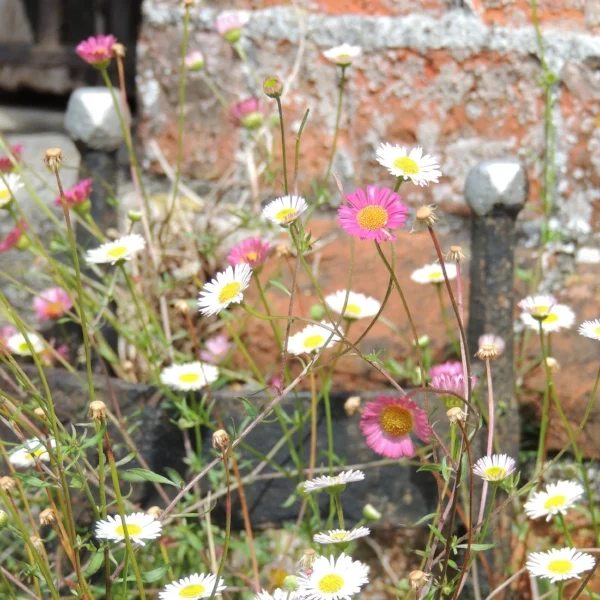
There's always . . .
something new to discover, even in the familiar. Every season brings a new way at looking at the city, from snow-capped to embellished with blossom to scattered with crisp leaves to sweltering under the summer sun.
A few months back, I discovered one of my favourite places in Winchester. My flatmates had gone home for spring break, but I stayed at university, slaving over assignments. Looking for somewhere to take a rest from work and catch up on reading, I stumbled upon Dean Garnier Gardens. It was abandoned except for a skinny robin jumping across the grass. The brick walls were clothed in thick ivy, the sun was out, and it finally felt like spring. Even though the garden is open to the public, it felt like a space of my very own; it felt personal.
Some days, when I’ve finished my work and the weather is nice, I’ll spend the day wandering around the streets of Winchester, trying to find somewhere I’ve never been. Occasionally I walk one of my favourite routes and try to spot things I’ve never noticed before: the mismatching brickwork of a building, mayweed growing at the edge of a footpath, a grave that’s older than the USA. There’s always something new to discover, even in the familiar. Every season brings a new way at looking at the city, from snow-capped to embellished with blossom to scattered with crisp leaves to sweltering under the summer sun. For a city that dates back to before Roman times, Winchester never gets old.
“there’s something strange and fantastic about popping into a grade II listed building for something as mundane as toothpaste.”
Jenny's second favourite thing is the connection with history. History is everywhere in Winchester. From the clock in the High Street that dates back to the late 19th century, to the Buttercross just behind it dating back even further to the 15th century, and who could forget the astounding Winchester Cathedral built in the 11th century. At least twenty of the buildings along the High Street now occupied by coffee shops, phone companies, and banks are grade II listed. This overlap between history and modernity creates a beautiful mix, giving Winchester significant heritage without stagnation. It creates a city that’s everchanging and evolving, but never losing sight of its roots. Plus, there’s something strange and fantastic about popping into a grade II listed building for something as mundane as toothpaste.
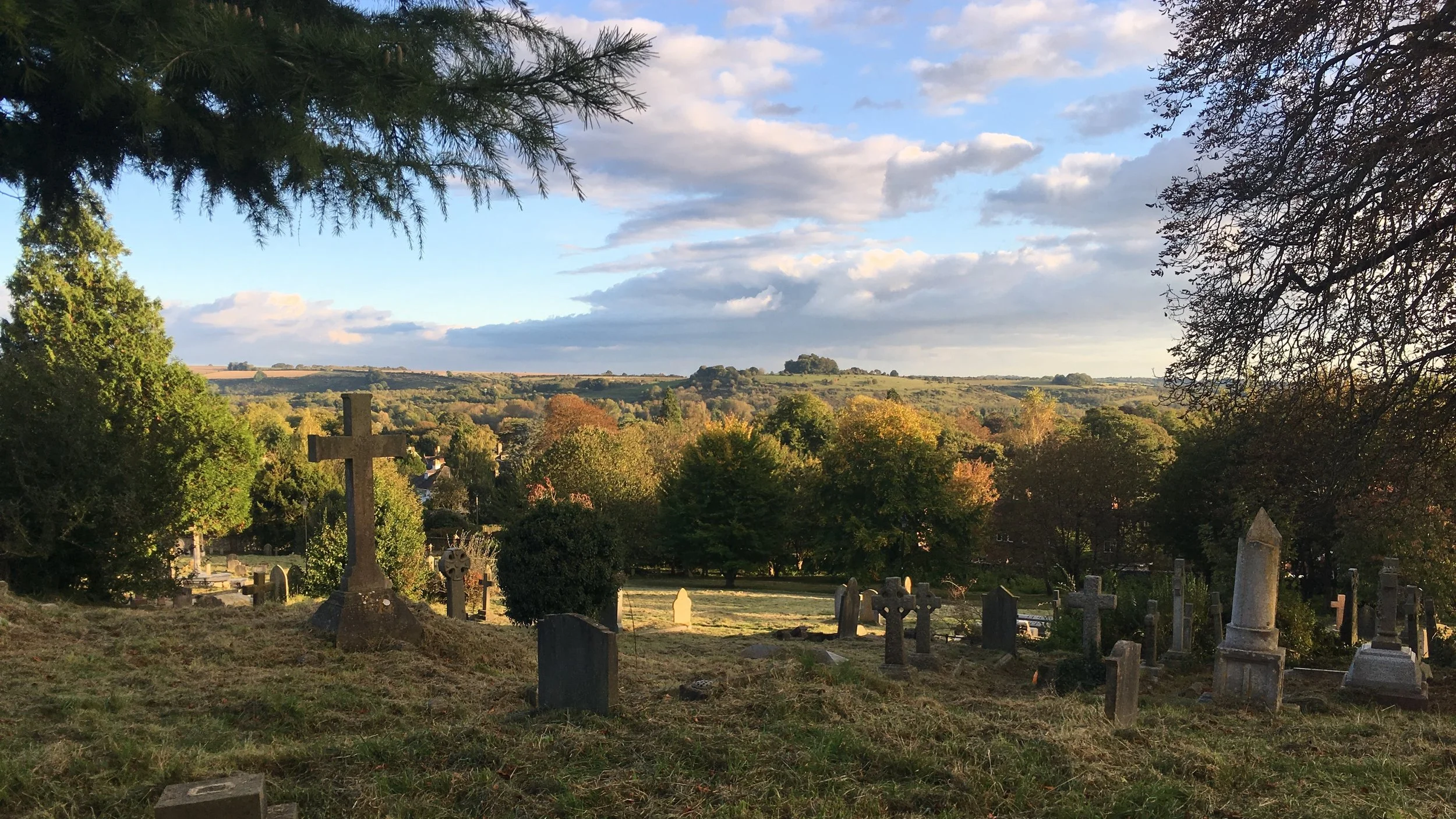
View from West Hill, a personal favourite of Jenny's
Jenny's third favourite thing are the countryside views. As well as brimming with beautiful architecture, Winchester is home to fantastic countryside views. From the city, it’s only a short walk to the Water Meadows (a favourite route of Keats’), or a bit further to St Catherine’s Hill in what feels like the heart of the countryside. Even within the city, there are plenty of peaceful green spaces to relax in, giving you a sense of nature without breaking out your walking boots. A personal favourite of mine, and ultimate winner for convenience, is West Hill Cemetery which is less than five minutes from the University of Winchester. From the bench at the top of the graveyard, you get one of the absolute best views in all of Winchester over the fields, trees, and hills that surround the city. It’s almost impossible to remember what you were so stressed about when staring out over that countryside landscape.

A city with a town vibe
Although Winchester is technically a city, and was even the capital of England for a time, it still feels intimate,
Jenny's fourth love is the town vibe. Despite containing so many open spaces, Winchester is pleasantly compact. It is Schrodinger’s city – both airy and cosy simultaneously. As someone who finds the idea of driving about as appealing as a sandpaper massage, it’s a huge relief that you can walk pretty much everywhere in Winchester. Even the places that you can’t walk are easy to get to via public transport, so you can have a day out at the Science Centre and still feel good about your carbon footprint. Although Winchester is technically a city, and was even the capital of England for a time, it still feels intimate, unthreatening, and much more like a town but with all the perks that a city has to offer.
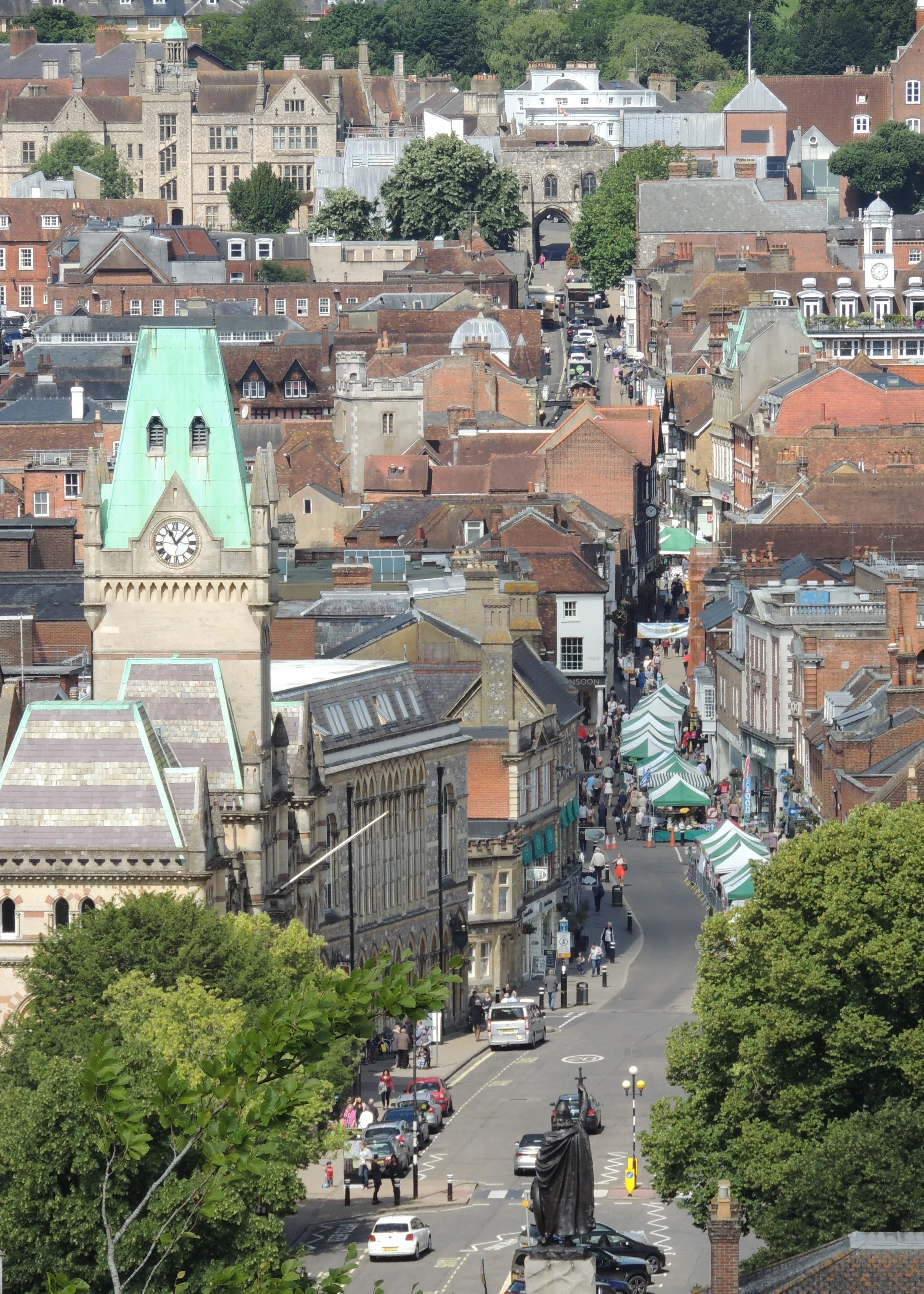
And finally
No description of Winchester would be complete without mentioning the High Street
Jenny's wonderful tour of Winchester finishes with the High Street. No description of Winchester would be complete without mentioning the High Street. If the Cathedral is the heart of the city, the High Street is undoubtedly a fundamental artery. Before coming to Winchester, all the buskers I’d ever encounter could just about eek out an off-key rendition of ‘Wonderwall.’ Even now, I still can’t get over the skill of the buskers by the Buttercross or next to Debenhams who make the chore of lugging shopping back to my flat that much more enjoyable.
Market day back home was nothing special. It consisted of a rotund man shouting about his courgettes and a shifty looking guy selling DVDs that had ‘fallen off the back of a lorry.’ Winchester is another story entirely. Walking through the High Street on market day is always an exercise in self-restraint. I’ll struggle past the stalls and try not to blow my student loan on the delicious smelling food from all over the world – Greece, Germany, Thailand and more. Sometimes I’ll kid myself that I’m ‘just looking’ and I won’t buy anything. But, as I have the breaking strain of a soggy Kit-Kat, on those occasions I rarely walk away without chowing down on an arancini or some other delicious street food. The Christmas market nearly bankrupted me I can tell you.
Of course, this list could easily be three times as long, as every day I learn something new about the city that just makes it more appealing. Know of any hidden gems or personal favourites about Winch that I haven’t mentioned? Feel free to share them down in the comments and help other people get to know this fantastic city!
Photo Credits - Jenny took the fabulous shot of the view from West Hill, and the remaining ones were taken by Becky Brown.